Effie Australia team
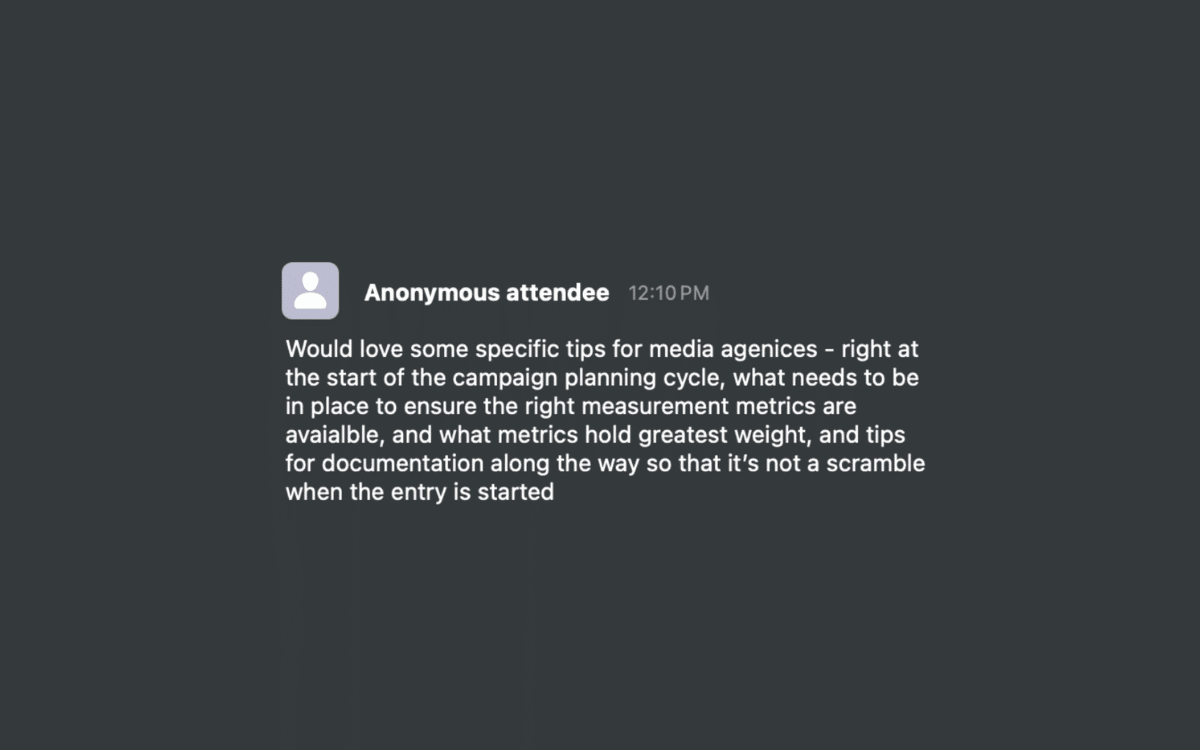
One question raised in our recent Effie webinar was ‘what needs to be in place at the start of a campaign to ensure the right metrics are available later, and how do you avoid the end-of-year scramble when it’s time to write the entry’.
Measurement should be an integral part of campaign planning, not something added after launch. Too often, agencies are asked to prove effectiveness using whatever data happens to exist at the end of a campaign. That usually means over-relying on platform dashboards, retrofitting a narrative and trying to connect business growth to media activity after the fact.
Effie judges aren’t just looking for results. They’re looking for evidence of causation, commercial impact, and clarity of thinking. The same kind of proof that the C-Suite wants when reviewing marketing budgets. This is best demonstrated by a measurement framework structured to show the link between in-market results and business results. Creating a link between the measurement layers and the objectives.
Start with the business problem and align all partners
Strong effectiveness cases are rarely built by one team. They come from aligned client, media, creative and analytics partners. Agree on:
- What success looks like
- Which metrics will be used
- How each metric is calculated
- Who owns which data source
- How often will the results be reviewed
Define incrementality upfront
One of the biggest differences between reporting and effectiveness is the challenge of proving causation. Results alone are not enough. You need to show what happened as a result of the media investment, not what would have happened anyway.
That means agreeing upfront:
- What is the baseline?
- What would happen without activity?
- How will seasonality be accounted for?
- Were there pricing or distribution changes in the market?
- What external factors could distort results?
For a commercial campaign, as well as having clearly defined objectives, a successful Effie will show brand health in the period preceding the activity (baseline) and how this has changed as a result of the activity.
What do we mean by brand health?
- At its simplest, this could include commercial outcomes such as sales, market share, and sales rate.
- In addition, using a greater consumer lens, brand penetration, brand awareness, and brand attributes.
- Data such as engagement with the creative work will serve to support the argument that the activity itself was a driver of the sales and brand measures
In competitive categories, the data also needs to demonstrate what is happening with the overall market and the competition, over baseline and active periods.
In bringing the case together to answer the question “How would you justify this to the Finance Director?”, there needs to be data on incremental sales, profit margin, and the cost of the activity (media and production) to calculate ROI.
For a social change campaign, the metrics may be more nuanced.
- There may be absolute numbers (e.g., the number of car accidents) or behavioural data (the incidence of smoking).
- If the case is about changing attitudes or behaviour, data is required on the attitudes that the activity is looking to affect, or the behaviours that are looking to be changed.
- There needs to be a baseline (pre-activity) and then a post-activity measure, so a clear impact can be demonstrated.
- Data such as engagement with the creative work will serve to support the argument that the activity itself was a driver of these attitudinal or behavioural changes.
Looking at the Social Return on Investment, the following are key:
- Metrics around the costs incurred (e.g., the cost of treating one smoker) or economic benefits gained (e.g., economic value of a life), which can then be used to show that the costs saved by society (or incremental economic impact)
- This saving or economic benefit can then be used in conjunction with the cost of the activity to calculate the social ROI
Where do traditional media and social metrics fit in?
In both categories (commercial and social), typical media metrics such as CPM, Penetration and Frequency, or social metrics such as likes, shares, or platform engagement metrics, can serve as supporting evidence but should not form the core evidence, which needs to come from in-market impact, behavioural change or attitudinal shifts.
Platform metrics should not be relied upon in isolation, given concerns about some attribution models and their potential to overstate commercial results.
The bottom line
Effectiveness is not just about buying well or reporting well. It’s about designing a measurement system that makes marketing’s contribution visible. Do that from day one, and when awards season arrives, you won’t be scrambling for proof. You’ll already have it.
If you find measurement gaps, entrants have credits available with Ideally as part of its support of the Effie Awards.
Ideally credits help to synthesise complex data or segmentation into clear insights, refine your narrative, provide robust and significant sample sizes to land your case with confidence, and strengthen proof on category context, competitors, distinctiveness, and message clarity.
Start with a hypothesis. Ideally runs the research, often overnight, on a nationally representative sample. The output is submission-ready data. Email effies@goideally.com to get access.
But be quick, the limited bank of credits is available on a first-come, first-served basis.
—-
Entries for the 2026 Australian Effie Awards close June 1. Download the entry kit here.