
By Paul Sinkinson, Managing Director Australia and Asia, Analytic Partners
Every marketer knows the feeling. The forecast wobbles, finance wants options by Friday, and the fastest way to look disciplined is to go dark for a quarter and wait it out. It feels responsible. But it rests on a misunderstanding of what happens when a brand goes quiet.
A pause is not a pause. To the market, it is forgetting.
Going dark is not a pause
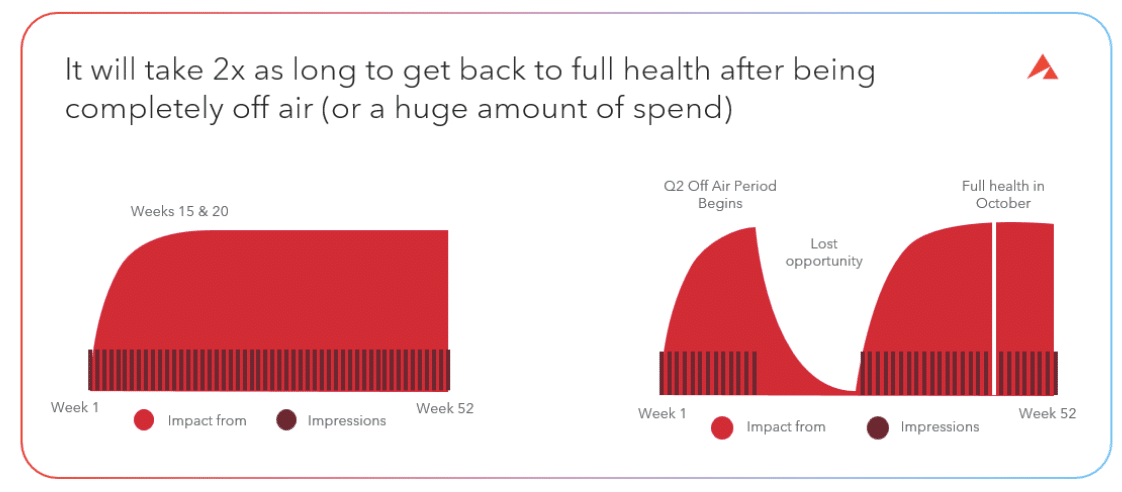
Here is what we see across the data at Analytic Partners. Our ROI Genome shows it takes 15 to 20 weeks of sustained advertising for a campaign to reach maximum impact. The build is slow because memory is slow. Switching off does not return you to where you paused. It sends you backwards.
The numbers are unforgiving. Our modelling shows a brand that goes completely dark takes around twice as long to climb back to full health as it took to lose it, and more than twice the spend you saved to get there in a hurry. Go dark in April and you may not be back to full strength until October. That is not a quarter of savings. It is six months of underperformance and a repair bill.
Worse, the damage is invisible when you decide and obvious only later. The hit to demand and brand recall surfaces months down the line, often at the exact point a marketer is trying to isolate the drivers of growth and prove an effectiveness outcome for an Effie submission.
So if going fully dark is rarely the answer, the instinct shifts to something that feels more measured: don’t switch everything off, just trim the channel pulling its weight the least. This is where good marketers get fooled.
So which channel do you trim?
The trouble starts with the number on the dashboard. Most reporting ranks channels by average ROI, and average ROI is the wrong number for a budget decision. It tells you how an investment performed in hindsight, not what the next dollar will do or what the dollar you remove is holding up. A channel can carry an ordinary average and still be your single largest contributor.
Search and display are where this catches people out. Both saturate fast: the highest-intent buyers convert first, every extra dollar reaches a less valuable audience, and the average looks tired. But a channel can be well into diminishing returns and still be the highest-returning thing you own in absolute terms. Cut it because the dashboard called it inefficient, and total return falls.
Then there is the part a channel-by-channel view cannot see: the channels are not independent. They prime and amplify each other. Analytic Partners’ ROI Genome shows that campaigns planned with coordinated channel roles, rather than channel-by-channel, can drive up to 35% higher ROI, and that a healthier balance between brand and performance can deliver ROIs up to 90% higher than over-indexing on performance alone. The uncomfortable implication for anyone reaching for the scissors: some of the conversions you are protecting were created by the brand activity you are about to cut.
Manage a portfolio, not a watchlist
The way out is to stop grading channels like a school report and start running them like a portfolio. An investor does not dump a holding because it had a soft morning, or judge each position as if the others do not exist. They manage to total return, knowing the parts move together and each sits at a different point on its own curve. The decision that matters is marginal, not average: where the next dollar earns most, and what the dollar you remove takes with it. Combining channels, formats and the right creative creates a multiplier that the dashboard, reading each line on its own, simply cannot see.
Birds Eye is the proof. Our analysis showed Birds Eye that years of product-by-product management had starved the masterbrand. Acting on it, they rebuilt brand presence and committed to a consistent rhythm, cutting the brand’s longest dark stretch from twenty-two weeks to five and since 2018 Birds Eye has more than tripled its marketing ROI.
None of that came from a bigger budget. It came from managing the whole portfolio rather than grading each channel alone.
The brands that win the hard years don’t cut on average ROI. They weigh what the next dollar in each channel will return, how channels lift each other, and what brand is holding up. Then they decide what not to touch.
Analytic Partners is a supporter of the 2026 Australian Effie Awards.