By Hannah Sturrock, National Head of Engagement, Advertising Council Australia
There’s a conversation happening right now about AI use that I think needs more exploration. What does it actually mean to use AI creatively, rather than just efficiently?
AI, by its nature, takes logical steps toward the most probable answer. That’s what makes it fast and useful and, at scale, a little worrying for creative industries. If you give ten agencies or creative teams the same brief and they all use AI to identify the insight and the strategic territory, you shouldn’t be surprised when they arrive at similar places.
Recent research showed LLM responses mirror other LLM responses far more than humans do other humans, further highlighting the significance of variability in human creativity. The research suggests “a danger of relying on generative AI models as creative partners…because their LLM “creative” partners may collectively drive them toward a mean”.
These tools are doing exactly what they were built to do. Probability is their design principle, and probability, in creative work, is another word for familiar. “Creativity thrives on heterogeneity of ideas, but today’s LLMs seem unable to provide these.”
Recently, I was facilitating a virtual bootcamp for our ten Australian Young Lions preparing to compete in Cannes, where AI use is permitted. We heard from two of last year’s global Young Lions jurors, Essence Mediacom’s Pippa Berlocher and BMF’s Christina Aventi, who both talked about the fatigue of seeing endless similar ideas, and the skill required to balance “fresh with familiar” as Christina calls it. They admitted that novelty, or ‘oddity’, can give ideas a real edge in the jury room, particularly when judges are working through a high volume of entries.
Strangeness, freshness, unexpectedness – these qualities become increasingly potent when everyone is using the same tools to find the same logical answer. Oddity becomes the only reliable way out of the pile.
Brian Eno understood this problem long before AI existed. His Oblique Strategies cards, developed with Peter Schmidt in the 1970s, were a deck of instructions designed to push musicians off the path of what felt correct. “Use an unacceptable colour.” “Work at a different speed.” “What would your closest friend do?” They weren’t random for randomness’s sake. They were tools for breaking the gravitational pull of the obvious, for people who had the nous to tell the difference between interesting and just wrong.
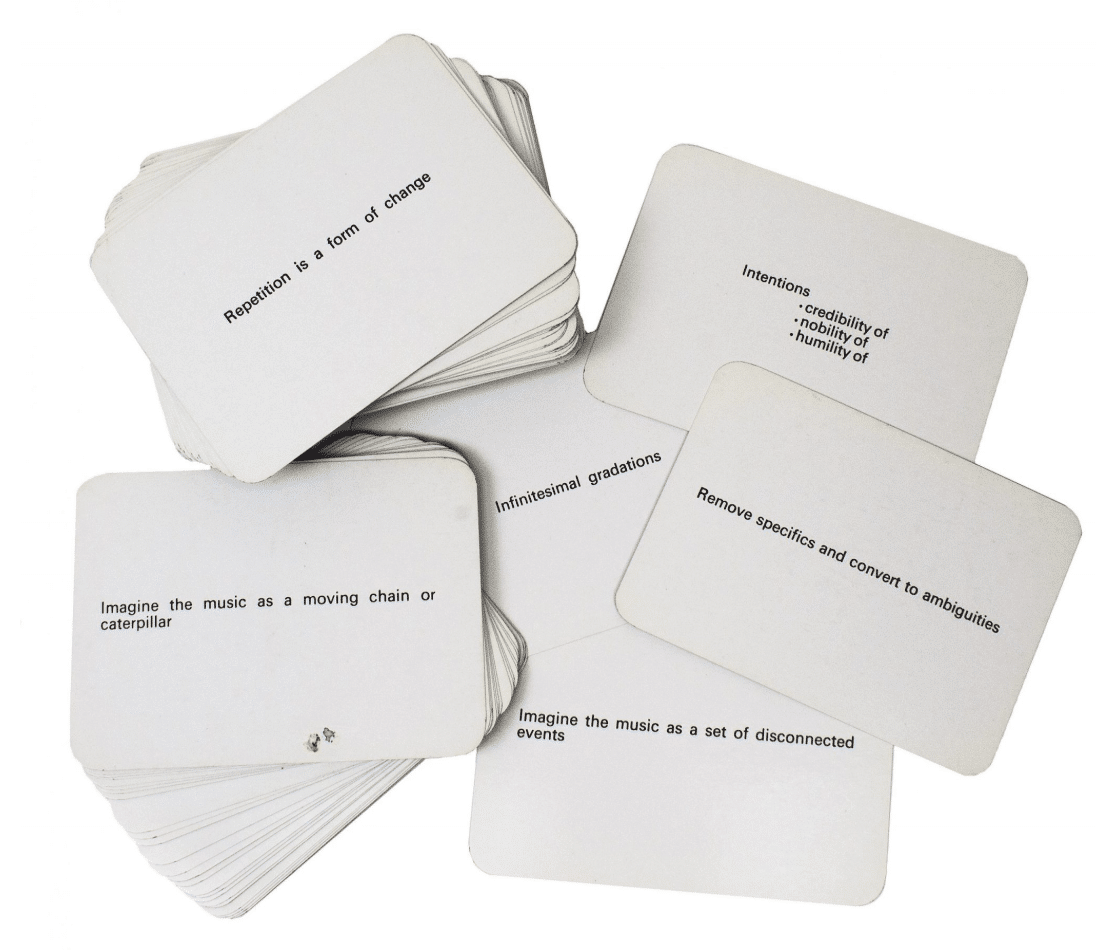
That last part matters, because the cards didn’t work on their own. The musician still had to recognise when the disruption had produced something worth keeping. One AI scientist called this tendency toward convergence “a form of compression: reducing a wide range of thought into a smaller set of patterns, and assuming what’s lost doesn’t matter, an assumption AI systems risk operationalizing at scale.” What gets lost in efficiency and productivity gains, is exactly what we should be protecting.
The same is true in creativity and innovation. The improbable idea doesn’t arrive by accident. It appears in fragments, half-formed connections and unexpected combinations. The creative skill is noticing these glitchy notions as worth pursuing.
We talk a lot about prompting skills and productivity gains, but much less about the judgment required to recognise something interesting when it surfaces. Knowing which tool does what matters, but the ability to identify the unusual, connect seemingly unrelated ideas, and follow a promising thread somewhere unexpected is a different skill entirely, and it’s the one that requires real creative training to underpin it.
The tools will keep getting better at logic, faster, cheaper, more capable of producing competent answers. But competence has never been the goal of creative industries. Distinctiveness is.
If AI converges by design, then our advantage may lie in cultivating the very thing it struggles to produce: oddity.