

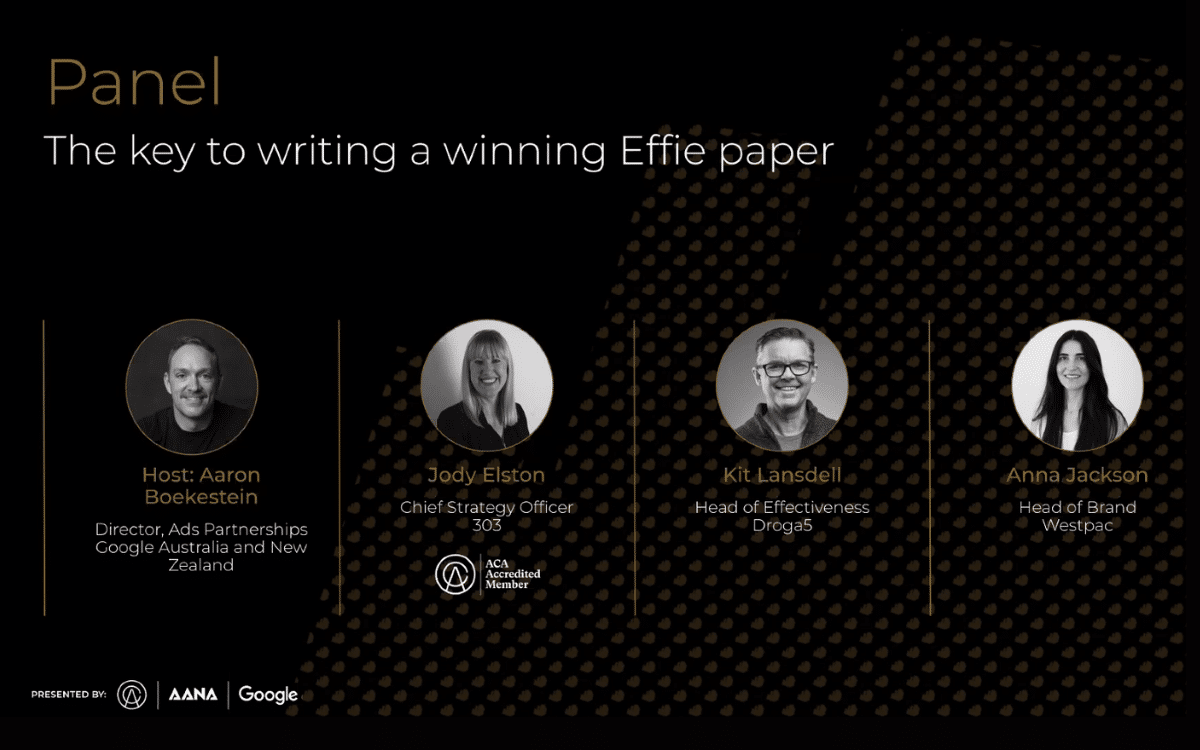
If you’re planning to enter the Australian Effie Awards, last week’s How to Enter & Win webinar showed what separates a decent entry from one that actually wins.
Effie judges, past winners from Westpac, Droga5 and 303, and effectiveness experts broke down how winning cases are built, from shaping the story to proving commercial impact.
Below are the sharpest takeaways. Enough to get you moving, but not enough to skip the recording.
AI won’t write your case, but it will buy you time
Aaron Boekestein, Director, Ads Partnerships, Google ANZ, reframed the role of AI in the Effie process.
“There’s a cyclic play in proving value in effectiveness,” he said. “AI should bring effectiveness and efficiency together, freeing up time to focus on strategy and storytelling, not spreadsheets.”
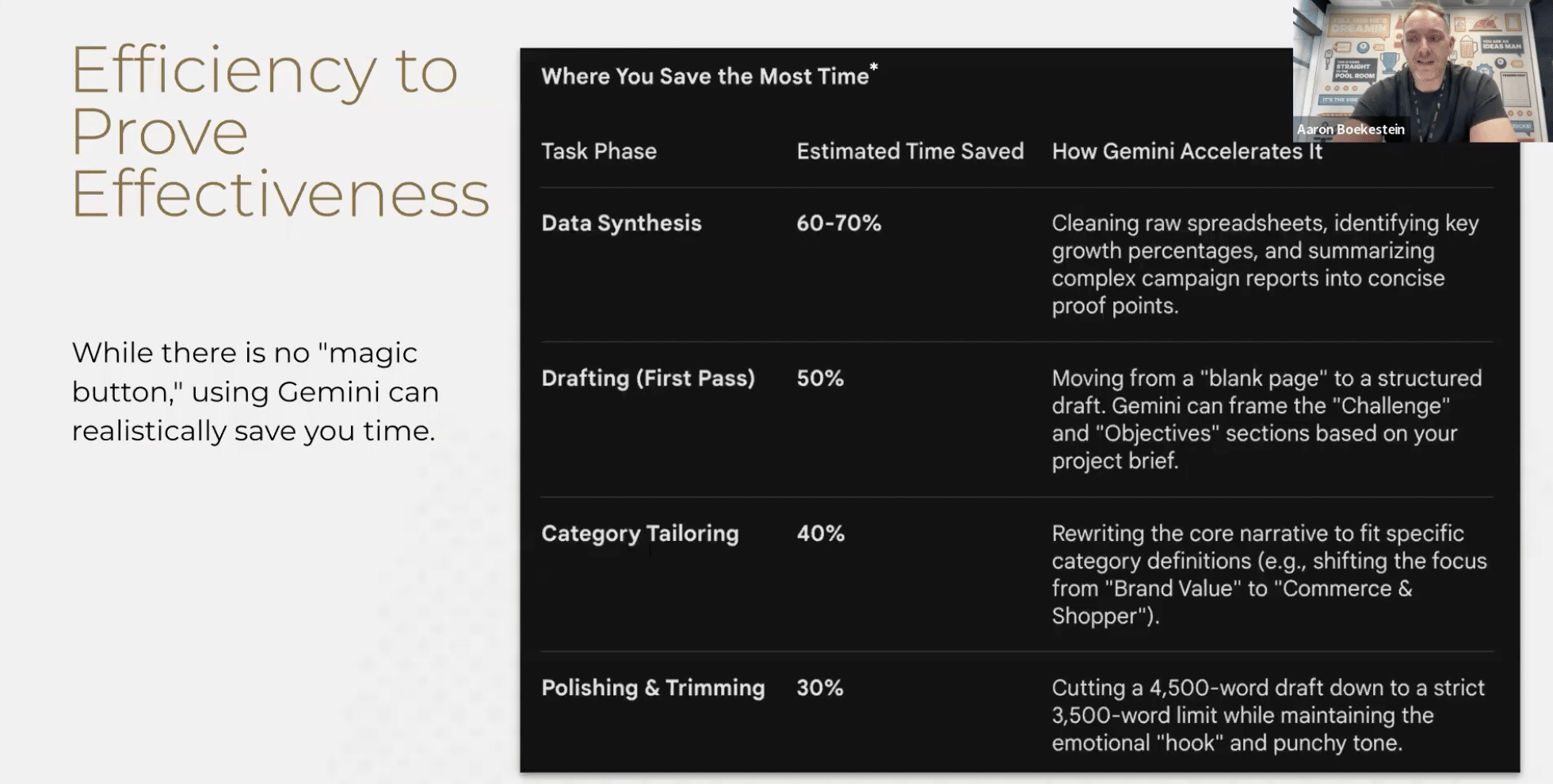
Used properly, tools like Gemini can synthesise data, test logic and surface gaps early. Boekestein estimates it can reduce the initial workload by up to 60–70%.
But the boundary is clear. While AI can sharpen the story, it cannot supply the proof (or truth).
23 mins in, Aaron shares the exact Gemini prompts used to fast-track entry writing. His slide on how much time the platform can save you when writing an Effie is below.
Use research to close the gaps
Free research credits from Ideally are available again this year to strengthen one of the weakest parts of most Effie cases: the evidence.
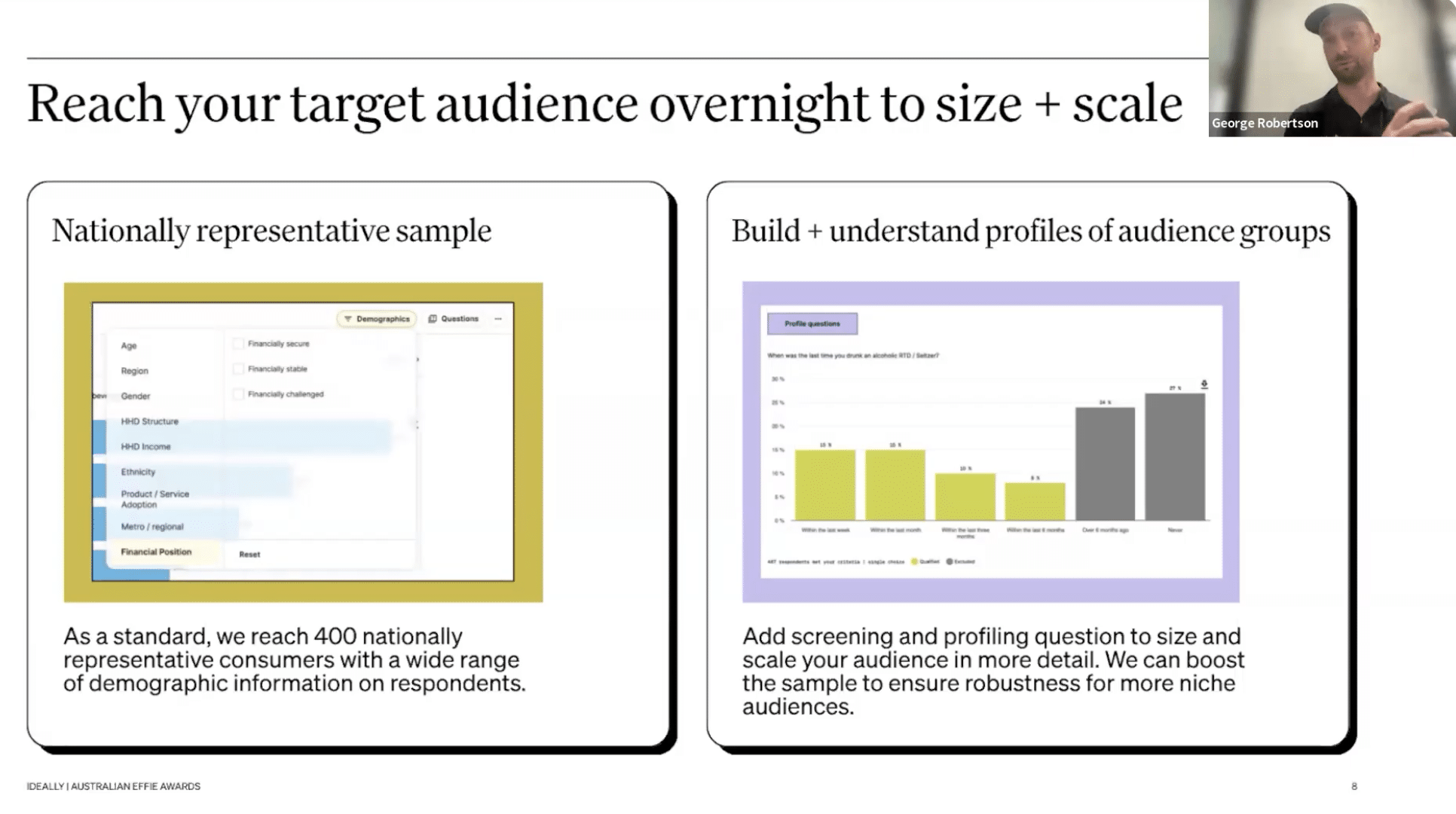
“Use consumers to help with the paper’s narrative. Most use cases have been to fill in missing data points on how the work has ‘worked’ against a category context” said George Robertson, Ideally’s Global Agency Lead.
The research can benchmark your work against the category, validate its distinctiveness, comprehension, appeal, and look at marketing science drivers to strengthen claims about commercial impact. It can also look at usage, attitudes, opinions and behaviours.
The process is simple. Start with a hypothesis. Ideally runs the research, overnight, with a nationally representative sample. The output is submission-ready data.
The proof point is in the Effie. The consumer is an integral part of the narrative of the Gold winners.
Credits are limited and most useful in the early stages. Watch George’s full session at 17 mins to see how to structure your hypothesis and how research credits can help you. Contact effies@goideally.com to kick things off and claim your credits.
The best Effie papers have teeth
Anna Jackson, Head of Brand at Westpac, pointed to one of the biggest issues holding entries back.
“The best Effie papers have teeth. Make that bold claim. What’s the strong point of view you want to prove?”
Too many cases, she said, fall into the same “boring” trap.
“You advertised and sales went up. So what? What’s missing is causality. What actually drove the result, why it mattered, and what the industry can learn from that.”
The strongest entries take a position, build a case around it and prove it with evidence. That requires pressure-testing early.
“What data is available to support it? You’ll know pretty quickly if it’s a hill worth climbing.”
That same rigour needs to extend beyond marketing. “Get the CFO on board. Commercial validity is a must,” she said.
The 9-week reality
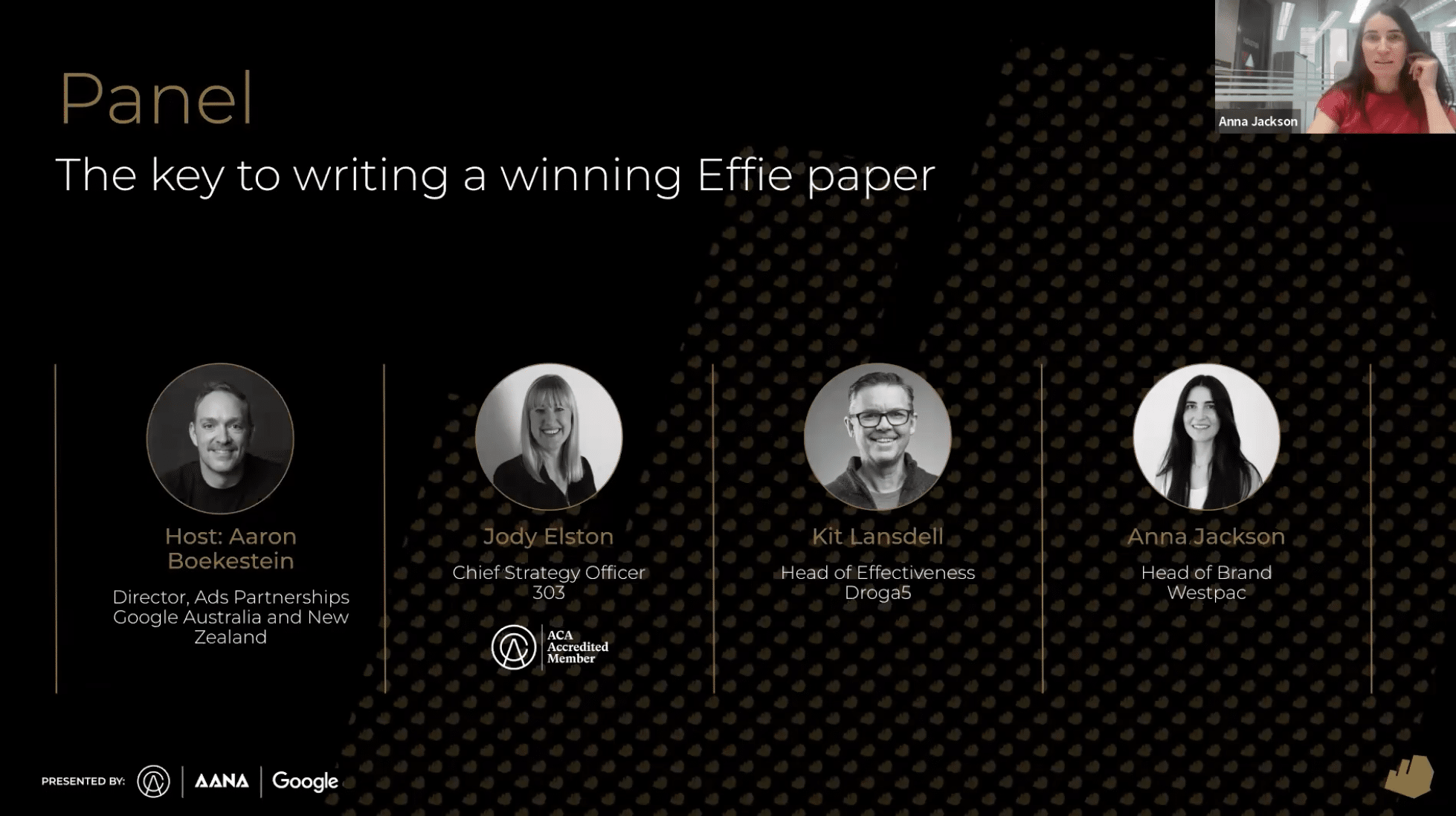
With around nine weeks until entries close, Jodi Elston, Chief Strategy Officer at 303, laid out a simple framework to use your remaining entry time wisely.
“Three weeks on the data, three on the story, three on approvals. And the data side’s never truly finished,” she said.
The mistake, she said, is thinking the work starts when the form opens. Strong cases are built earlier, through how teams track and interrogate performance.
Her advice is straightforward. Start with the data. Bring stakeholders in early. Build the story, don’t retrofit it.
“Hopefully you’ve started. If not, get cracking.”
Effectiveness is proven
For Kit Lansdale, Head of Effectiveness at Droga5, the process is about understanding the work, not packaging it.
“Effectiveness isn’t a one-off. How can we improve it, strengthen it, build on the work?”
That means being honest about the results.
“You can’t make up results. If the data doesn’t hold, judges will know.”
The Effies endure for a reason
Chair of Judging Colin Wilson-Brown said the Effies remain a benchmark because they prove what works.
With entries now open, the challenge is simple. Show not just what you made, but what it moved.
“If it’s not effective, it’s not marketing,” he said.
***
Download the entry kit and explore the new categories here. On-time entries close May 4.